третья ссылка по вот этому запросу + meaning
2026-08-14 18:04
telegramjopniytt
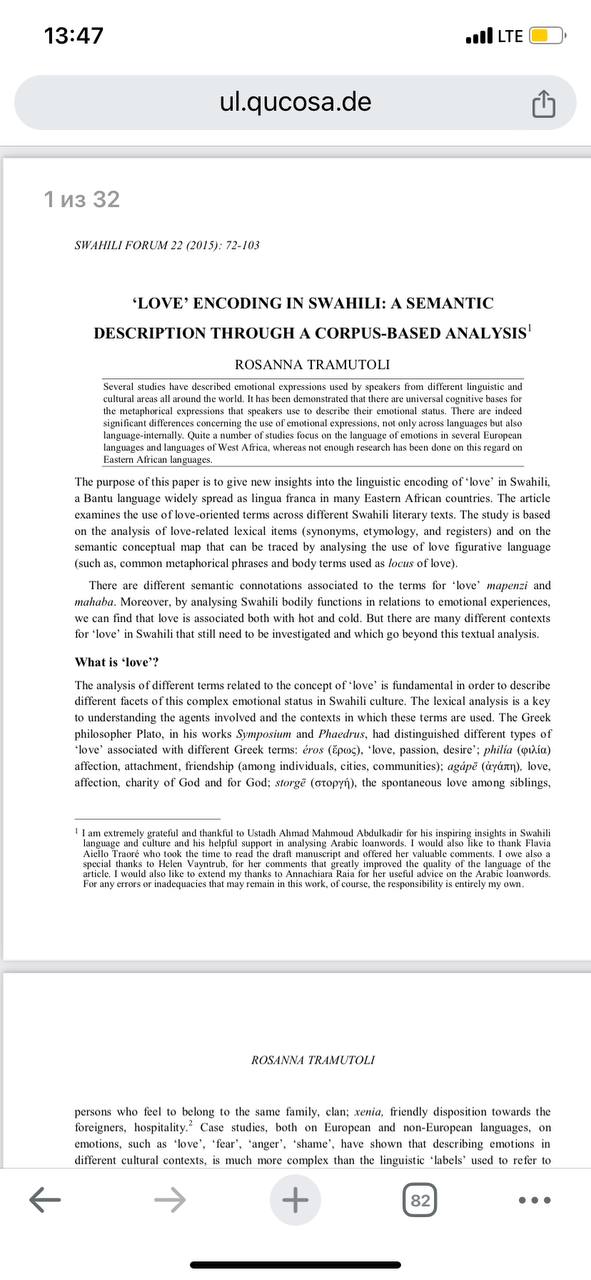
OCR
Текст, распознанный с картинки.
13:47
ul.qucosa.de
Лиз 32
SWAHILI FORUM 22 (2015); 72-103
‘LOVE’ ENCODING IN SWAHILI: A SEMANTIC
DESCRIPTION THROUGH А CORPUS-BASED ANALYSIS
ROSANNA TRAMUTOLI
Several studics have described emotional expressions used speakers from different linguistic and
cultural areas all around the world, It has been demonstrated that there are universal cognitive bases for
the metaphorical expressions that speakers use to describe their emotional status, There are
significant differences conceming the use of emotional expressions, not only across languages but also
language-intemally. Quite a number of studies focus on the language of emotions in several European
languages and languages of West Africa, whereas not cnough research has been done on this regard on
Eastem languages.
The purpose of this paper is to give new insights into the linguistic encoding of ‘love’ in Swahili,
а Bantu language widely spread as lingua franca in many Eastern countries. The article
examines the use of love-oriented terms across different Swahili literary texts. The study is based
on the analysis of love-related lexical items (synonyms, etymology, and registers) and on the
semantic conceptual map that can be traced analysing the use of love figurative language
(such as, common metaphorical phrases and body terms used as of love).
There are different semantic connotations associated to the terms for ‘love’ mapenzi and
mahaba. Moreover, analysing Swahili bodily functions in relations to emotional experiences,
we can find that love is associated both with hot and cold. But there are many different contexts
for ‘love’ in Swahili that still need to be investigated and which beyond this textual analysis.
What is ‘love’?
The analysis of different terms related to the concept of ‘love’ is fundamental in order to describe
different facets of this complex emotional status in Swahili culture. The lexical analysis is a key
to understanding the agents involved and the contexts in which these terms are used. The Greek
philosopher Plato, in his works Symposium and Phaedrus, had distinguished different types of
‘love’ associated with different Greek terms: éros (Epws), ‘love, passion, desire’; philia
affection, attachment, friendship (among individuals, cities, communities); agdpé love,
affection, charity of God and for God; storgé (сторуй), the spontancous love among siblings,
Lam extremely grateful and thankful to Ustadh Ahmad Mahmoud Abdulkadir for his inspiring insights in Swahili
language and culture and his helpful support in analysing Arabic loanwords. 1 would also to thank Flavia
Aicllo Traoré who took the time to read the draft manuscript and offered her valuable comments. 1 owe also a
special thanks to Helen Vayntrub, for her comments that greatly improved the quality of the language of the
article, would also like to extend my thanks to Annachiara Raia for her useful advice on the Arabic loanwords.
For any errors or inadequacies that may remain in this work, of the responsibility is entirely my own,
ROSANNA TRAMUTOLI
persons who feel to belong to the same family, clan; xenia, friendly disposition towards the
foreigners, hospitality.’ Case studies, both on European and non-European languages, on
emotions, such as ‘love’, ‘fear’, ‘anger’, ‘shame’, have shown that describing emotions in
different cultural contexts, is much more complex than the linguistic ‘labels’ used to refer to
lang: ru+en
Пользовательские термины
Свои поисковые фразы (до 280 символов). При поиске по термину счётчик растёт.
Пока нет пользовательских терминов.
Похожие мемы