SharinGAN: Combining Synthetic and Real Data for Unsupervised Geometry Estimation Supplementary Material Koutilya PNVR Hao Zhou* David Jacobs kout i [email protected] [email protected] djacobs@umiac
2026-08-08 14:30
telegramkek_inside
OCR
Текст, распознанный с картинки.
SharinGAN: Combining Synthetic and Real Data for Unsupervised Geometry
Estimation
Supplementary Material
Koutilya PNVR Hao Zhou* David Jacobs
kout i [email protected] [email protected] [email protected]
University of Maryland, College Park, USA.
1. More Implementation details
The discriminator architecture we used for this work у
в:
3,1), 2)} {FeBR(1024),
FcBR(512), where, CBR(out channels, kernel
size, stride) Conv BatchNorm2d ReLU and
nodes) Fully conncected BatchNorm1D ReLU and
is a fully connected layer. For face normal estimation, we у
not use batchnorm layers in the discriminator. We use
the value К 2 for MDE and К 1 for FNE.
Face Normal Estimation We update the generator 3
times for cach update of the discriminator, which in turn
is updated 5 times internally as per 3]. The generator
from a new batch each time, while the discriminator
trains on a single batch for 5 times.
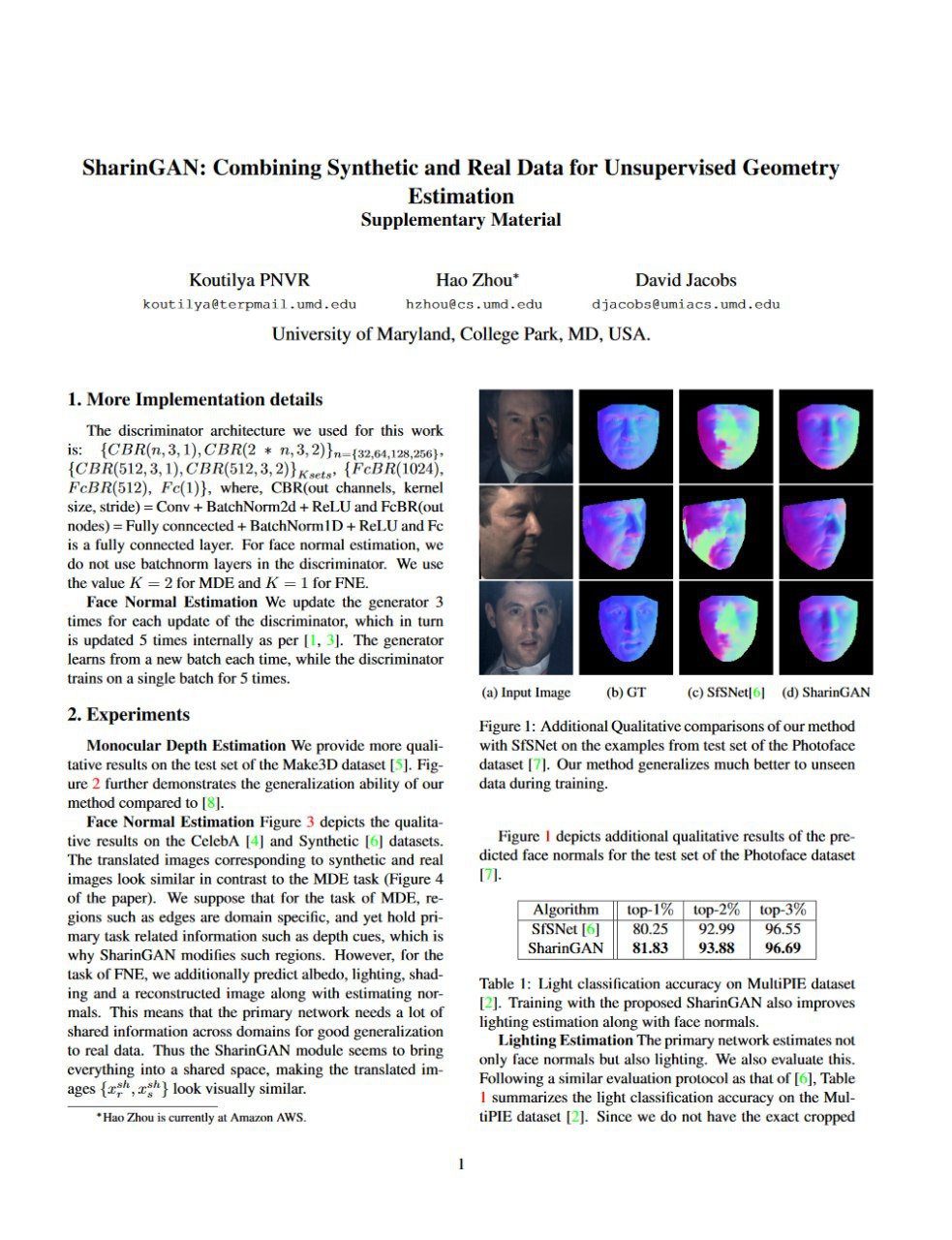
(a) Input (4) SharinGAN
2. Experiments Figure 1: Additional Qualitative comparisons of our method
Monocular Depth Estimation We provide more SfSNet on the examples from test set of the Photoface
tative results on the test set of the Make3D dataset [5]. Fig- dataset [7]. Our method generalizes much better to unseen
ure 2 further demonstrates the generalization ability of our during training.
‘method compared to
Face Normal Estimation Figure 3 depicts the qualita-
tive results on the CelebA [4] and Synthetic [6] datasets Figure depicts additional qualitative results of the pre-
‘The translated images corresponding to synthetic and real face normals for the test set of the Photoface dataset
images look similar in contrast to the MDE task (Неше4
the paper). We suppose that for the task of MDE,
gions edges specific, and yet hold pri- Algorithm top-1% top-2% top-3%
mary task related information such as depth cues, which is SfSNet [6] 80.25 92.99 96.55
why SharinGAN modifies such regions. However, for the SharinGAN 95:88" 1969
task of FNE, we additionally predict albedo, lighting, shad- classification accuracy on dataset
ing and a reconstructed image along with estimating nor- a
mals. This means that the primary network needs а lot of Training with the proposed SharinGAN also improves
shared information across domains for good along wilh face
to real data. Thus the SharinGAN module seems to bring
everything into а shared space, making the translated face normals bul also lighting. We alko tis.
‘ollowing a similar evaluation protocol as that of [6], Table
ages look visually similar. 1 summarizes the light classification accuracy on the Mul-
Zhou at Amazon AWS, dataset [2]. Since we not have the exact cropped
1
lang: ru+en
Пользовательские термины
Свои поисковые фразы (до 280 символов). При поиске по термину счётчик растёт.
Пока нет пользовательских терминов.
Похожие мемы