I will schizopost
2026-09-27 02:19
telegramthe_high_council_of_frens
OCR
Текст, распознанный с картинки.
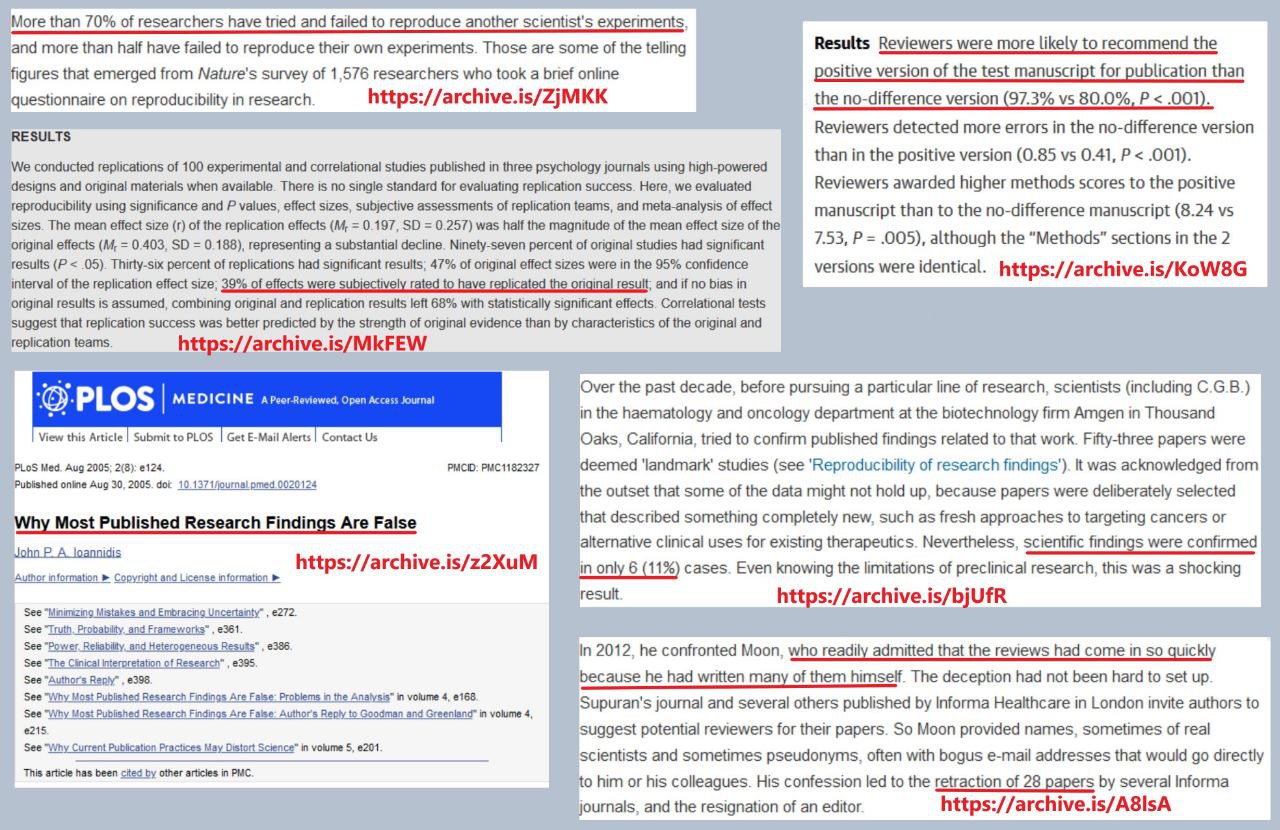
More than 70% of researchers have tried and failed to reproduce another scientist's experiments,
‘and more than half have failed to reproduce their own experiments. Those are some of the telling Results Reviewers were more likely to recommend the
gures that emerged from Nature's survey of 1,576 researchers who took a brief online itive version of the test manuscript for publication than
questionnaire on reproducibility in research. the no-difference version (97.3% 80.0%, .001).
RESULTS Reviewers detected more errors in the no-difference version
than in the positive version (0.85 0.41, .001).
designs and original materials when available. There is no single standard for evaluating replication success. Here, we evaluated Reviewers awarded higher methods scores to the positive
using significance and values, effect sizes, subjective assessments of replication teams, and meta-analysis of effect manuscript than to the no-difference manuscript (8.24
sizes. The mean effect size of the replication effects 0.197, 0.257) was half the magnitude of the mean effect size of the
original effects 0.403, 0.188), representing а substantial decline. Ninety-seven percent of original studies had significant 7.53, .005), although the “Methods” sections in the 2
.05). Thirty-six percent of replications had significant results; 47% of original effect sizes were in the 95% confidence versions were identical. https: //archive.is/KoW8G
interval of the replication effect size; 39% of effects were subjectively rated to have replicated the original result, and if no bias in
original results is assumed, combining original and replication results left 68% with statistically significant effects. Correlational tests
suggest that replication success was better predicted the strength of original evidence than characteristics of the original and
eplication teams. https://archive.is/MkFEW
PLOS the past decade, before pursuing a particular of research, scientists C.G.B.)
in the haematology and oncology department at the biotechnology firm Amgen in Thousand
View this Article Submit to PLOS Get E-Mail Alerts Contact Oaks, California, tried to confirm published findings related to that work. Fifty-three papers were
PLoS Med. Aug 2005; 2(8): PMCID: РМС1182327 deemed ‘landmark’ studies (see of research findings’). It was acknowledged from
Aug 30, 2005. dot 10.137 pmed 0020128 the outset that some of the data might not hold up, because papers were deliberately selected
Most Published Research Findings Are False that described something completely new, such as fresh approaches to targeting cancers or
A alternative clinical uses for existing therapeutics. Nevertheless, scientific findings were confirmed
https://archive.is/z2XuM in only 6 (11%) cases. Even knowing the limitations of preclinical research, this was a shocking
result. https://archive.is/bjUfR
See “Minimizing Mistakes and Embracing Uncertainty”
See "Truth, and Frameworks”
In 2012, he confronted Moon, who readily admitted that the reviews had come in so quickly
See "Author's Reply” because he had written many of them himself. The deception had not been hard to set up.
Set los journal and Several others published Informa in London invite authors to
suggest potential reviewers for their papers. So Moon provided names, sometimes of real
scientists and sometimes pseudonyms, often with bogus e-mail addresses that would directly
о him or his colleagues. His confession led to the retraction of 28 papers several Informa
journals, and the resignation of an editor. https://archive.is/A8IsA
lang: ru+en
Пользовательские термины
Свои поисковые фразы (до 280 символов). При поиске по термину счётчик растёт.
Пока нет пользовательских терминов.