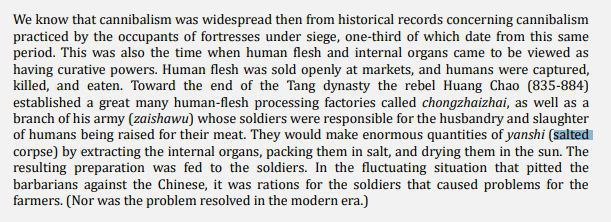
We know that cannibalism was widespread then from historical records concerning cannibalism practiced the occupants of fortresses under siege, one-third of which date from this same period. This was a
2026-09-27 01:52
telegramthe_high_council_of_frens
OCR
Текст, распознанный с картинки.
We know that cannibalism was widespread then from historical records concerning cannibalism
practiced the occupants of fortresses under siege, one-third of which date from this same
period. This was also the time when human flesh and internal organs came to be viewed as
having curative powers. Human flesh was sold openly at markets, and humans were captured,
killed, and eaten. Toward the end of the Tang dynasty the rebel Huang Chao (835-884)
established a great many human-flesh processing factories called chongzhaizhai, as well as a
branch of his army (zaishawu) whose soldiers were responsible for the husbandry and slaughter
of humans being raised for their meat. They would make enormous quantities of yanshi (Salted!
corpse) extracting the internal organs, packing them in salt, and drying them in the sun. The
resulting preparation was fed to the soldiers. In the fluctuating situation that pitted the
barbarians against the Chinese, it was rations for the soldiers that caused problems for the
farmers. (Nor was the problem resolved in the modern era.)
lang: ru+en
Пользовательские термины
Свои поисковые фразы (до 280 символов). При поиске по термину счётчик растёт.
Пока нет пользовательских терминов.